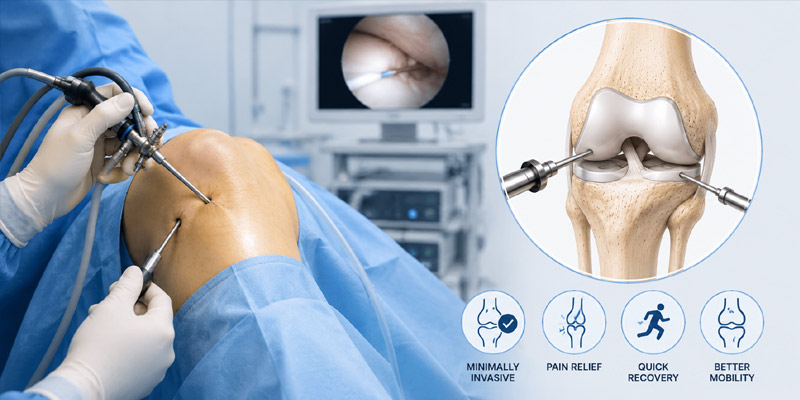
Knee pain, instability, locking, or difficulty while walking, running, climbing stairs, or playing sports may be due to ligament or cartilage injury inside the knee. At Jeshwanth Orthopaedics, we offer advanced evaluation and treatment for sports injuries of the knee, including ACL tears, meniscus tears, and other conditions managed through knee arthroscopy surgery.
If you are searching for the best ACL surgeon in Chennai, best meniscus surgeon in Chennai, or knee arthroscopy surgeon, it is important to choose a specialist who can accurately diagnose the problem and provide the right treatment plan. Our aim is to relieve pain, restore knee stability, improve function, and help patients return safely to daily activities and sports.
What is Knee Arthroscopy?
Knee arthroscopy is a minimally invasive keyhole surgery used to diagnose and treat problems inside the knee joint. Through small incisions, a camera and specialized instruments are inserted into the knee to treat ligament injuries, meniscus tears, loose bodies, cartilage damage, and other internal knee problems. Compared with open surgery, arthroscopic knee surgery usually offers:

Minimally Invasive Approach
Smaller incisions and less soft tissue damage compared with open surgery, resulting in lower postoperative discomfort in selected patients.

Better Joint Visualization
The arthroscopic camera provides superior visualization of the knee joint interior, allowing accurate assessment of ligament, meniscus, and cartilage damage.

Faster Recovery & Early Rehabilitation
Arthroscopic knee surgery typically allows faster recovery in many cases with earlier initiation of rehabilitation and return to daily activities.
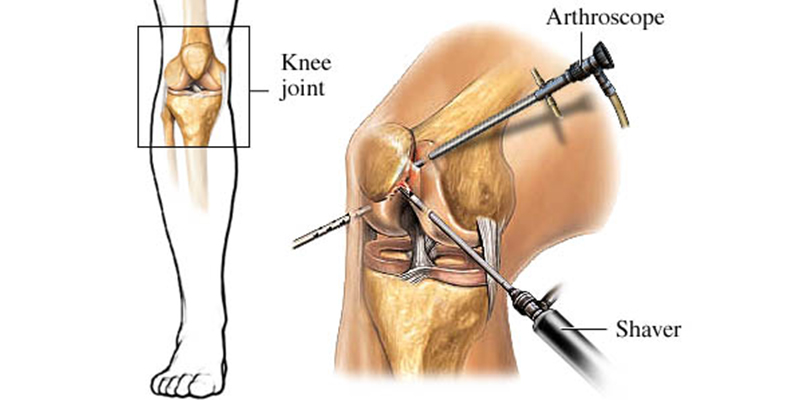
Knee arthroscopy surgery in Chennai is commonly performed for sports injuries and mechanical knee symptoms, and is one of the most effective minimally invasive procedures for restoring knee function in carefully selected patients.
ACL Injury & Meniscus Injury
Two of the most common conditions treated through knee arthroscopy are ACL tears and meniscus tears. Understanding each condition helps in choosing the most appropriate treatment for each patient's situation.
ACL Injury
The anterior cruciate ligament (ACL) controls forward movement and rotational stability of the knee. An ACL tear commonly occurs during sports, twisting injuries, or sudden changes in direction, causing knee giving way, instability, pain, and swelling. If untreated, it may lead to repeated instability and increased risk of meniscus and cartilage damage.
Meniscus Injury
The meniscus is a cartilage cushion inside the knee that absorbs shock and improves joint stability. A meniscus tear can result from sports injury, twisting, squatting, or trauma, causing joint line pain, swelling, locking or catching sensation, and difficulty bending or straightening the knee.
Other Knee Conditions
We evaluate and treat a wide range of knee conditions including cartilage injury, loose body in knee, synovial problems, knee instability, multi-ligament injuries, recurrent knee swelling, chondral defects, and selected PCL and ligament-related injuries.
ACL Reconstruction & Meniscus Surgery
When the ACL is completely torn and the knee remains unstable, ACL reconstruction surgery may be recommended. This is usually performed through knee arthroscopy, using a graft to reconstruct the torn ligament and restore stability to the knee. For meniscus injuries, treatment depends on the pattern and location of the tear and may include meniscus repair — stitching and saving the torn meniscus — or partial meniscectomy, where the damaged unstable part is trimmed arthroscopically. The aim of both procedures is to relieve pain, restore movement, improve knee stability, and prevent further joint damage where possible.
Our Approach to Knee Arthroscopy
At Jeshwanth Orthopaedics, treatment for ACL injury and meniscus tear is planned with a focus on detailed history and mechanism of injury, clinical examination, MRI and imaging review, assessment of knee stability, evaluation of associated cartilage or ligament injury, personalized treatment planning, arthroscopic surgical precision, and structured rehabilitation and return-to-activity guidance. Every knee injury is different — the right treatment depends on the patient's age, activity level, sports goals, tear pattern, instability, and associated damage inside the knee.
Personalized Treatment Planning
Each patient receives a customized surgical plan based on their specific knee condition, tear pattern, activity level, sports goals, and associated joint damage identified on examination and imaging.
Structured Rehabilitation & Recovery
Recovery after ACL or meniscus surgery includes swelling control, range-of-motion exercises, muscle strengthening, balance and stability training, gait training, and gradual return to daily activity and sport-specific rehabilitation where needed.
Long-Term Follow-Up Care
Structured post-operative follow-up ensures recovery is on track, concerns are addressed promptly, and the best long-term outcome is achieved for every patient returning to activity and sports.
Got questions? we've got answers!
Knee arthroscopy is a minimally invasive keyhole surgery used to diagnose and treat problems inside the knee joint. It is commonly recommended for patients with ACL tears, meniscus tears, cartilage injury, loose bodies, knee instability, or mechanical symptoms such as locking and catching that have not responded to non-surgical treatments.
Not every ACL tear or meniscus tear needs immediate surgery. The decision depends on symptoms, age, activity level, sports demands, associated injuries, and functional instability. A detailed clinical examination along with MRI evaluation helps determine whether surgery, physiotherapy, or a combination is the most appropriate treatment for each individual patient.
Recovery after knee arthroscopy or ACL reconstruction depends on the exact procedure performed, severity of injury, associated damage, and adherence to the rehabilitation protocol. Recovery involves swelling control, pain management, range-of-motion exercises, muscle strengthening, balance training, and gradual return to activity. Sport-specific rehabilitation is included where needed for patients aiming to return to sports.
Knee arthroscopy is one of the most commonly performed and well-established orthopaedic procedures. Patients typically experience improved knee stability, relief of locking and catching, better knee function, and an overall improvement in quality of life. At Jeshwanth Orthopaedics, every surgery is planned with thorough preoperative evaluation, arthroscopic surgical precision, and a structured rehabilitation programme for safe and effective outcomes.